
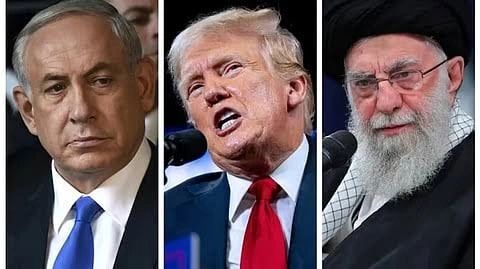
Israel-Iran Conflict: Ceasefire or Just a Pause Before Full-Scale War?
The recent 12-day conflict between Israel and Iran, temporarily halted by a US- and Qatar-brokered ceasefire announced by President Donald Trump on June 23, 2025, has left more questions than answers. While it exposed deep strategic vulnerabilities—particularly for Iran—it failed to deliver decisive outcomes for either side.
Israel entered the conflict with ambitious goals: toppling the Khamenei regime, dismantling Iran’s nuclear infrastructure, neutralizing its ballistic missile capabilities, and crippling its regional proxy network. Despite executing precise and technologically advanced airstrikes, none of these objectives were fully achieved. Iran’s leadership remained intact, its nuclear program—hidden deep within fortified sites like Fordow—survived, and its proxy networks, though weakened, remain functional and active.
On the other side, the war laid bare Iran’s growing military vulnerabilities. Iran’s outdated air defense systems, still reliant on the aging Russian-made S-300s, and decades-old jets, proved woefully inadequate against Israeli aerial superiority. Israel’s intelligence capabilities allowed it to obliterate several top-tier military leaders within hours of the conflict’s onset, and it exposed severe weaknesses in Tehran’s counter-intelligence operations. Without a modern air force or effective air defenses, Iran’s capacity to militarily counter Israel in the long run appears unsustainable.
Yet, Iran did manage to display some resilience. Its retaliatory missile strikes on Israeli territory and a symbolic attack on a US military base in Qatar—though all intercepted—served to show its defiance, if not strength. Interestingly, the attack on the US base is widely viewed as part of a behind-the-scenes arrangement between Washington and Tehran. The move allowed Iran a face-saving gesture while minimizing actual damage—a pattern that underscores the theatrical nature of this conflict.
A key strategic outcome was Israeli Prime Minister Benjamin Netanyahu’s success in drawing the United States into the confrontation. Under mounting pressure from pro-Israel lobbies and Republican voter bases, President Trump authorized limited strikes on three Iranian nuclear sites. However, the damage was minimal and not sufficient to alter the trajectory of Iran’s nuclear ambitions.
Neither Israel nor Iran can claim victory. Israel’s military superiority is unquestionable but insufficient to achieve regime change or permanently halt Iran’s nuclear program without either ground operations or sustained American involvement. Iran, meanwhile, is too defensively crippled to win any conventional war but has the ability to endure, adapt, and retaliate through asymmetric warfare and attrition.
For the United States, the broader geopolitical costs loom large. With over $36 trillion in national debt and ongoing commitments in Ukraine, Washington is wary of becoming entangled in another Middle Eastern quagmire. Trump, who returned to power on promises to end endless wars, faces immense pressure from his MAGA voter base to avoid another costly intervention.
The current ceasefire is fragile. As confirmed by both Iranian and Israeli officials, it is merely a temporary arrangement—more a test of Trump’s diplomatic influence than a path toward sustainable peace. With neither side achieving their core objectives and their military infrastructures still largely intact, a return to full-scale war appears inevitable once both camps recalibrate and regroup. The Middle East, once again, teeters on the edge.




Nice Blog. Good write-ups on this site…
Nice writeup
Who wrote this?….Great Analysis
Vrryu nice write ups
Good work
Awesome blog